
Japan Has Already Pulled the Trigger
The bubble will blow in our face

Everyone is waiting for the Japan moment, the one we described many times. The moment when Japanese investors finally sell their Treasuries, repatriate their capital, and send global yields into a spiral the market isn’t equipped to absorb. The moment when the Bank of Japan’s normalization crosses some invisible threshold and the carry trade unwinds in a way that can’t be contained. The moment when thirty years of artificially suppressed rates come back as a global shock.
That moment is not coming. It already happened. You were watching the wrong clock.
The Architecture of a Thirty-Year Subsidy
To understand what has changed, you have to understand what existed. For three decades, Japan ran the most consequential monetary arrangement in modern finance. The Bank of Japan pinned its policy rate at or below zero, bought JGBs at whatever scale was necessary to suppress yields, and turned Japan’s bond market from a price-discovery mechanism into a policy instrument.
The direct consequence was that Japanese institutional investors, life insurers, pension funds, trust banks managing trillions in household savings, had no reason to stay home. Domestic bonds offered nothing.
So they left, and they kept leaving, building a foreign asset position that reached 533 trillion yen in external assets, with $1.19 trillion sitting in US Treasuries alone as of Q1 2026, making Japan the single largest foreign holder of American sovereign debt.
That position did not accumulate through some exotic strategy. It accumulated because there was no alternative. A life insurer running a liability-matching book cannot hold bonds yielding 0.1% against actuarial obligations running at 2%. You go abroad or you fail.
So Japan went abroad, for three decades, and became the silent foundation of global rate suppression. Japanese institutions bought US Treasuries, Australian government bonds, French OATs, investment-grade credit, and equity. They were the marginal price-insensitive buyer of global duration. And because they were price-insensitive, by necessity rather than preference, they compressed term premium everywhere they touched.
That is the architecture that is now reversing. Not because of a crisis. Because the domestic logic that drove the outflows has inverted.
The Trigger Nobody Named
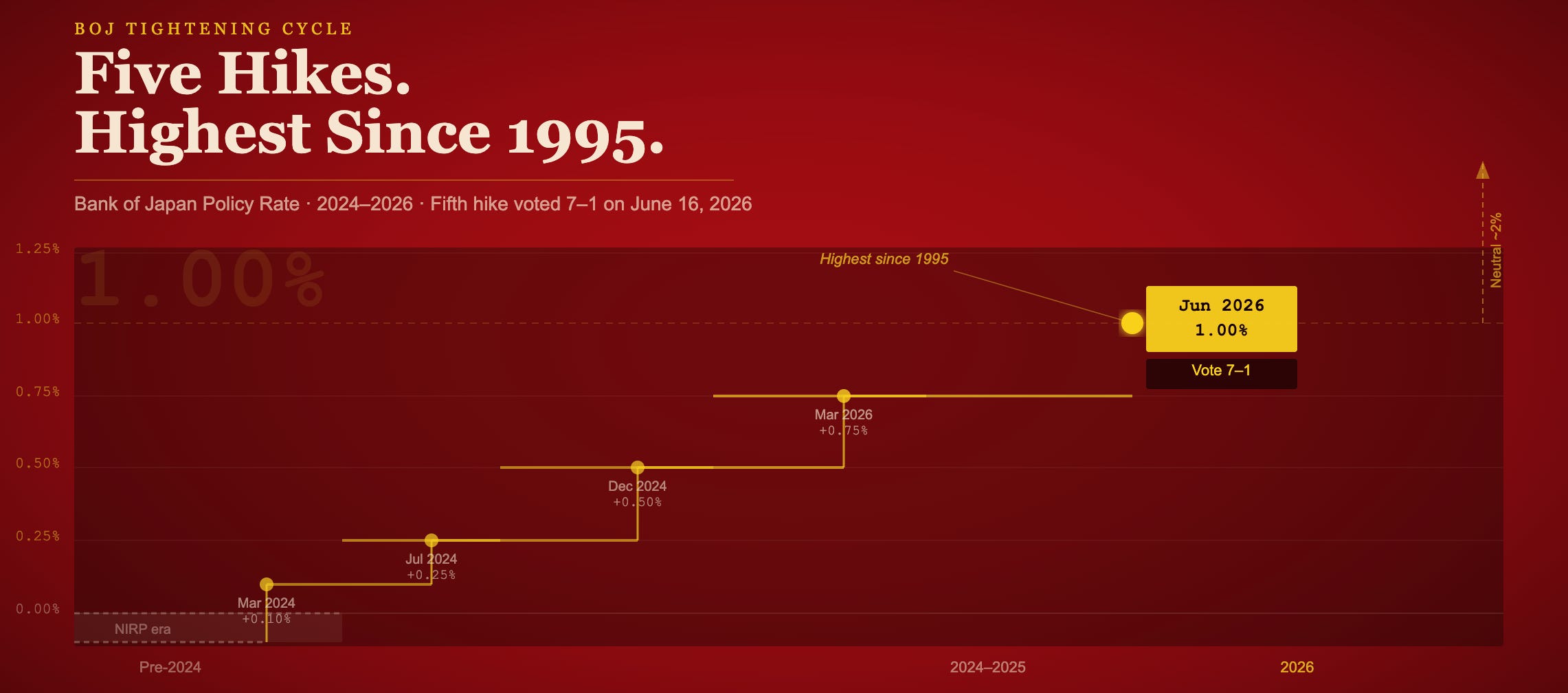
The Bank of Japan raised its policy rate to 1% on June 16, voting 7-1, the highest level since 1995. It was the fifth hike since 2024. Board member Naoki Tamura has stated publicly that rates should rise toward a neutral level of around 2%, at intervals of a few months, and that if inflation risks intensify the BOJ should accelerate “without hesitation.” Deputy Governor Ryozo Himino has confirmed that the BOJ sees upside risk to its inflation target and will keep hiking while monitoring price dynamics. Japan’s CPI inflation exceeded 2% in 45 of the 49 months ended April 2026. Core-core inflation, excluding fresh food and energy, has been at or above 2% for 41 of the last 43 months.
This is not a central bank hedging its options. This is a central bank that has made a decision and is executing it.
Meanwhile, the BOJ has been cutting its monthly JGB purchases from 5.7 trillion yen in August 2024 to 2.9 trillion yen in early 2026, on a path to 2.1 trillion by early 2027, after which it has explicitly stated that long-term interest rates should be determined by financial markets. The 10-year JGB touched 2.73% in May, its highest since 1997. The 30-year broke 4% for the first time in the history of that maturity, a level that did not exist in the prior regime. The 40-year reached 3.69%.
The market narrative on all of this has been consistent and consistently wrong. It says: the BOJ is hiking, so watch for the moment Japanese investors start selling. It treats this as a future event. It is looking for a phase transition that has already occurred at the level of flow data.
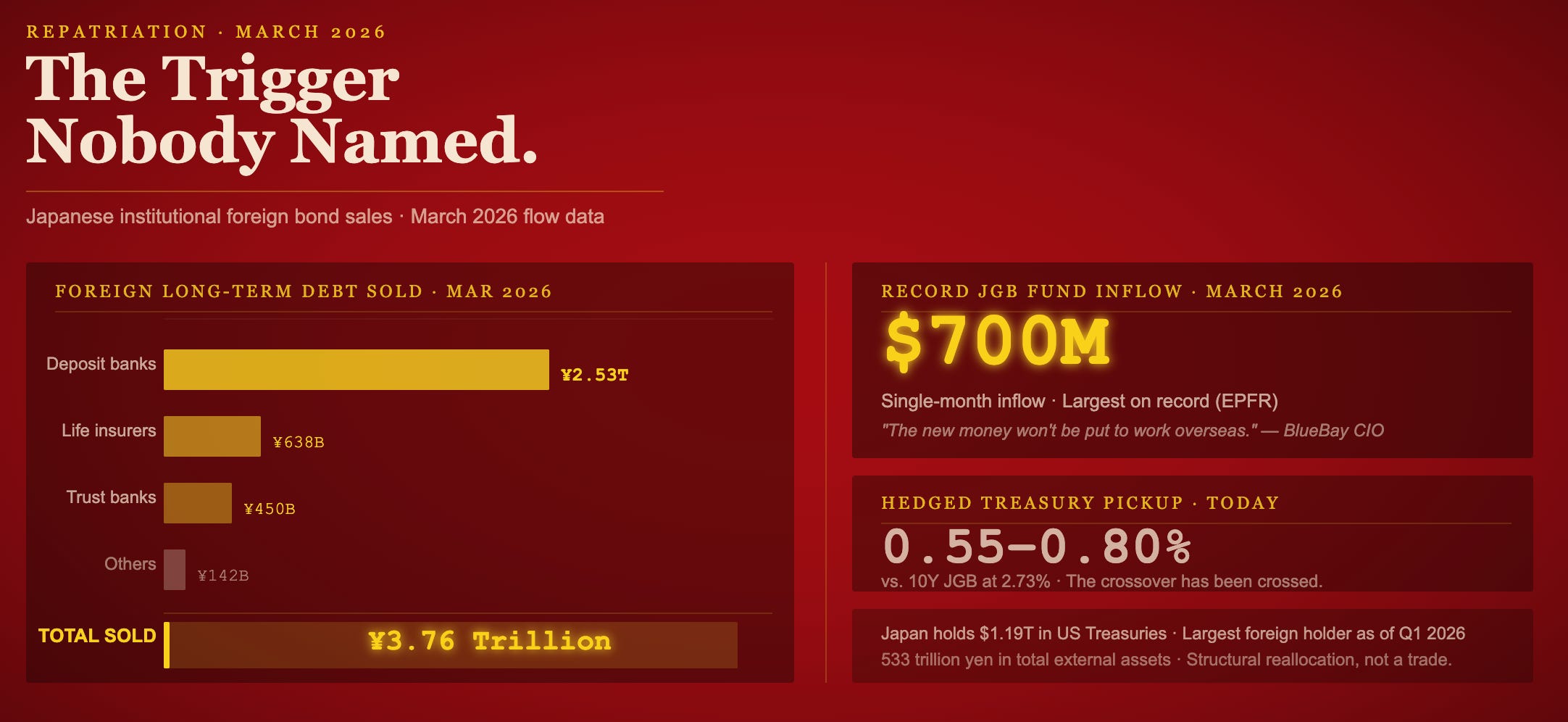
In March 2026, Japan’s designated major institutional investors sold 3.76 trillion yen of foreign long-term debt in a single month. Life insurers sold 638 billion yen of foreign bonds in the same period. Deposit-taking institutions sold 2.53 trillion yen. Japanese sovereign bond funds saw their largest monthly net inflow on record, approximately 700 million dollars, according to EPFR data. Mark Dowding, chief investment officer at BlueBay, was direct: “The new money that’s being put to work won’t be put to work overseas.” BlueBay launched its first Japanese bond fund in March 2026. Matt Smith at Ruffer holds a long yen position as a core hedging tool and has described the institutional signal as unambiguous: bring the money back.
The trigger was pulled in March. The question now is not whether repatriation starts. It is how fast it accelerates.
The Math That Makes It Structural
The carry trade that funded three decades of Japanese outflows rested on a simple calculation: the yield pickup from holding foreign bonds, after hedging the currency risk, exceeded what was available domestically. That calculation has reversed.
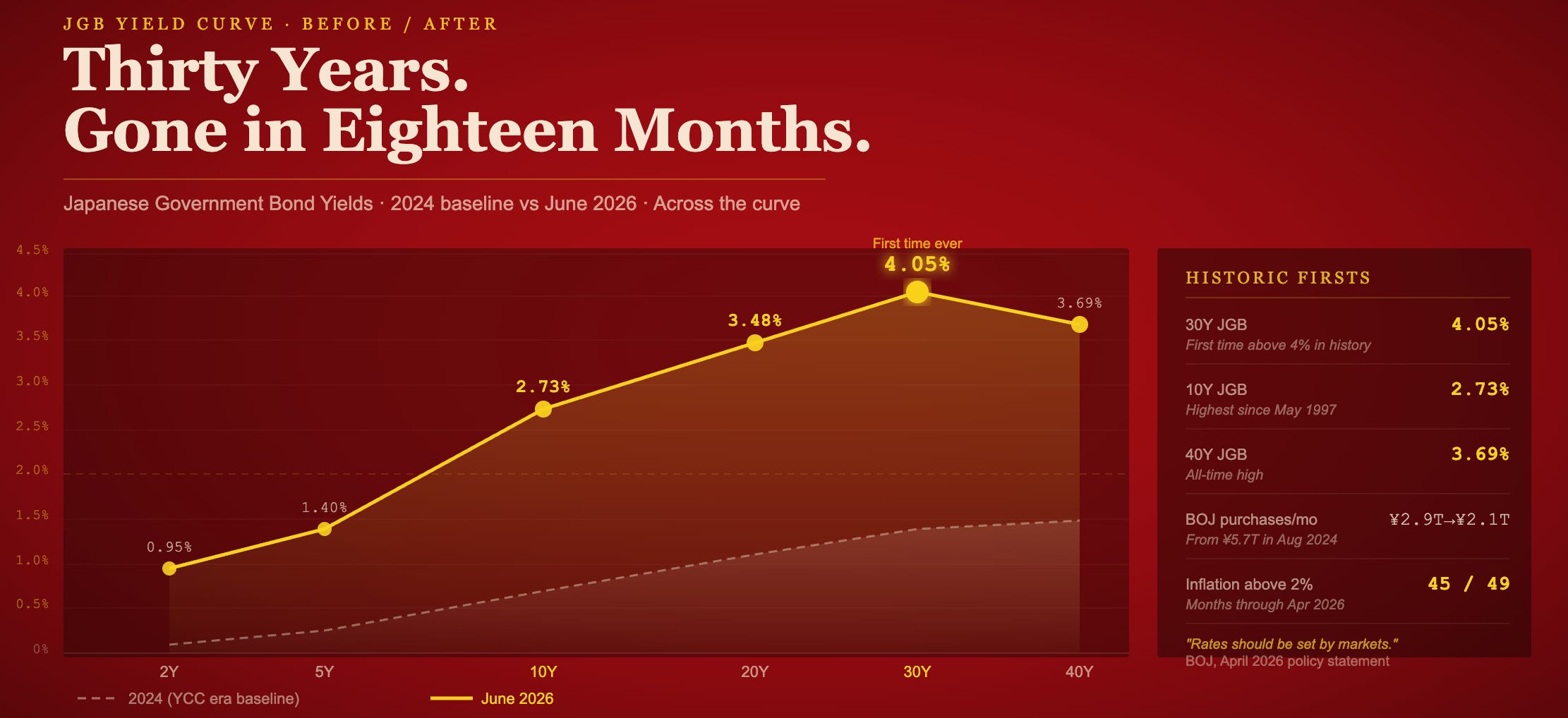
A yen-based investor holding a fully hedged 10-year US Treasury now retains approximately 0.55 to 0.80 percentage points of pickup after basis costs. The 10-year JGB at 2.73% is no longer dead weight. For the first time in a generation, Japan’s domestic bond market is a credible competitor for domestic savings. The crossover point, the level at which JGBs stop being an afterthought and start being a genuine allocation destination, has been crossed.
This creates a structural, not cyclical, pull on foreign assets. It does not require a crisis, a policy panic, or a sudden shift in institutional preference. It requires only that the marginal yen of savings, the yen that would previously have flowed into US Treasuries by default, flows instead into JGBs. The cumulative effect of that marginal reallocation, across the 533 trillion yen external asset base, is measured in hundreds of billions of dollars over the coming years.
The acceleration dynamic is reinforced by timing. BOJ purchases are scheduled to continue declining through early 2027. The BOJ has explicitly exited the role of yield suppressor in its own market. Private Japanese demand for JGBs must now step in. And as the BOJ exits, JGB yields continue to rise, improving the domestic return profile further, and pulling more capital home. The feedback loop is not stabilizing. It is self-reinforcing.
As argued in Japan will doom us all, due to oil, Japan’s energy import bill and its monetary response were always intertwined. The Iran war added an oil-price component to Japan’s domestic inflation, which provided the political and economic cover for a BOJ that was already moving toward normalization. What the war accelerated, the underlying rate and inflation structure now sustains independently of oil.

Where the Two Long Ends Collide
The market has been focused on the Federal Reserve’s long end as a domestic US phenomenon: term premium rebuilding as Warsh institutionalizes a new framework, PCE at 3.6%, dots pointing to hikes. As argued in The Fed Is Not Coming Back, that repricing is structural, driven by the destruction of the old Fed communication regime and the removal of the implicit backstop the market had priced for fifteen years.

What the market has not yet priced is the simultaneous compression from the Japanese side.
Consider the mechanical interaction. US Treasuries are priced, in part, by the marginal demand from foreign holders. Japan has been the single largest foreign buyer for decades. Japan is now pivoting from automatic, price-insensitive buyer to selective, returns-driven allocator. The March flow data confirmed this in practice. The BOJ’s own purchase reduction schedule confirms it in policy. The domestic return calculus confirms it in economics.
On one side: a US term premium rebuilding because the domestic monetary anchor has shifted.
On the other: a structural reduction in the foreign marginal buyer of US duration. These two forces are not independent. They are moving in the same direction simultaneously.
The 30-year US Treasury at 4.87% is not an equilibrium rate. It is a rate set in a world where both forces are still being absorbed by a market that has, so far, treated them as separate stories. They are not separate stories. They are the two long ends of the same global repricing, the American one driven by the Warsh framework, the Japanese one driven by three decades of monetary suppression ending at the same moment.
The portfolio implications follow the same logic as Architecture of the Next Cycle: any asset whose valuation was implicitly built on structurally suppressed global long rates carries unacknowledged duration risk. That covers private credit, long-duration equity multiples, infrastructure, real estate, and any credit structure that assumed refinancing into a world of falling terminal rates.

The specific Japan implication that is not yet in prices: the yen. As Ruffer’s Smith noted, yen appreciation will happen slowly at first, then accelerate suddenly. A stronger yen is the mirror of a weaker dollar bid for Treasuries. The positions built on USD/JPY above 150 were built on the assumption that carry differentials would persist. The BOJ at 1% and moving toward 2%, against a Fed holding at 3.5-3.75%, has compressed that differential to its tightest since before the era of Japanese quantitative easing began. The positions that need to unwind are not small.
The Japan moment is not a future risk. It is a present condition with a lag. The trigger was pulled in March. The mechanism is the structural reversal of thirty years of forced outflows. What comes next is not an event. It is a process, and it has started.
Normandie Research is an independent publication producing strategic analysis at the intersection of geopolitics, economic statecraft, capital flows, and financial markets. This analysis is provided for informational purposes only and does not constitute investment advice or a solicitation to buy or sell any financial instrument. Readers should conduct their own due diligence and consult qualified financial advisers before making any investment decision.
The line about long-duration equity multiples carrying unacknowledged duration risk is the part that connects directly to what we track. A stock trading at 80 or 100 times earnings is really a bet on discounting decades of future cash flow at a low rate, so it behaves less like a stock and more like a long-duration bond. If Japan genuinely stops being the reflexive, price-insensitive buyer of foreign duration, the discount rate embedded in every one of those high-multiple growth names moves against them regardless of what the underlying business does. Most investors are watching earnings risk on these names. Very few are pricing in the rate mechanism sitting underneath the multiple itself.
Japan has spent decades being the example of ultra-low rates and easy money. If that era is truly ending, the implications go far beyond Japan. Global bond markets, currency flows, and even borrowing costs elsewhere could all feel the ripple effects. Definitely a story worth watching closely.